0, Lene Baadsvig Ørmen (2022)
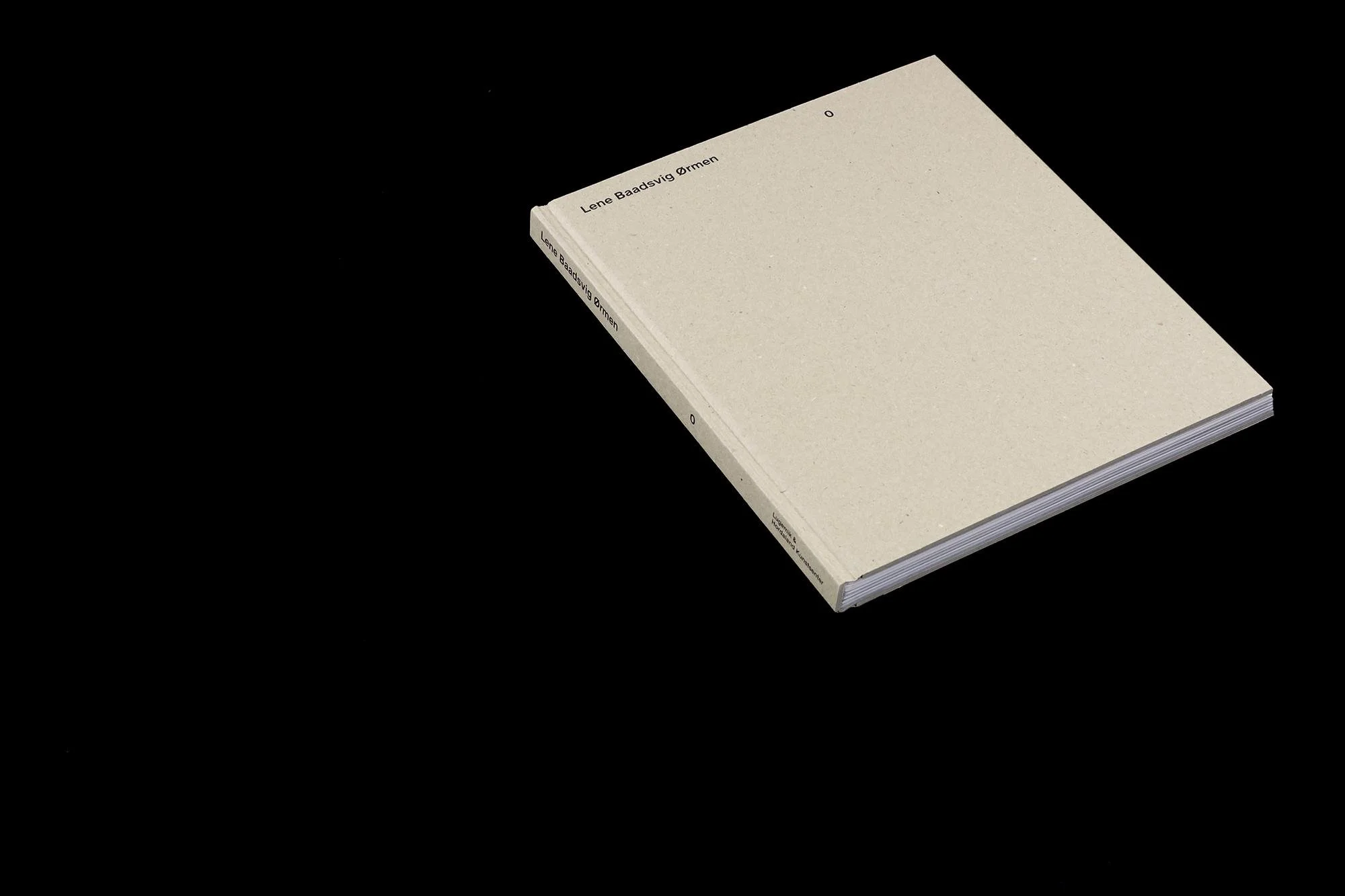
0, Lene Baadsvig Ørmen (2022).
Edited by Mathijs van Geest. Published by Lugemik & Hordaland Kunstsenter, 2022.
Text by Ki Nurmenniemi.
-
An encounter with Lene Baadsvig Ørmen’s sculptures might just be one of their perceived timeline. Being in the presence of Lene’s sculptural installations always tends to confuse my own sense of here and now. It feels like time suddenly warping around me, allowing my imagination to drift to myriad possible histories and futures.
These experiences of temporal distortions have to do with how Lene, through her sculptural language, interrogates the idea of history as an ongoing chronological development. In her sculptures, the fascination with cyclical time takes forms that simultaneously echo of the past, the present, and possible futures. They feel like beings or cultures that have first thrived and then perished, leaving behind signs and symbols that present day earthlings cannot easily decipher. Or perhaps I am looking at traces of worlds that still exist, but in another corner of the multiverse. In Lene’s oeuvre, the linear and cyclical conceptions of time seem to intersect and complement each other.
Lene’s artworks do not seem to be from this time, nor from any other defined point in time. They do not point to any particular system of meaning and thus resist clear-cut categorizations. However, there is integrity and an internal logic to each body of work. They are based upon, in Milena Høgsberg’s words, “an alphabet I do not have access to.” The syntax of Lene’s sculptures only begins to unfurl when one takes time to attune to the particular language of each of the materials used and the multiplicity of meanings the materials make when combined. In the artist’s own words: “In an alphabet formed by metals, aluminium is one of the letters and bronze is another one.”
Lene is sensitive towards how linguistic and descriptive systems evolve in an intimate relationship with the amorph stuff of the world. The feminist theorist and theoretical physicist Karen Barad has argued that matter and meaning evolve in relations that can best be described as intra-actions.¹ The best response I can utter to Barad’s brilliant theorizations is that everything happens in a kind of material-discursive dance. It is quite challenging to attune to the languages used by philosophers and scientists, and therefore artistic attempts to investigate the materiality of language, and the language of materiality, deserve our attention. In this book, Lene, in conversation with artist Lea Beereframm, discusses the language of science and how much the underlying assumptions about the world dictate what kinds of questions scientists are able to pose, how these inquiries limit the range of the possible. What is an artist to do then? To develop engaging questions and to widen the scope of the possible.
Language is always a matter of approximation, and Lene feels an especially strong pull towards the realms of the ineffable. She is often finding ways to tackle phenomena that escape current scientific attention or methods. She is curious about the traces that cultures leave behind for the generations and other cultures to come, and the attempts at translation happening in the encounters between different systems of description. Something will always be lost in the translation process, something always gained. What is certain is that meanings will be morphed; the dancing goes on.
THE PUSH AND PULL BETWEEN MATTER AND MEANING
In Lene’s artistic practice, matter and meaning are inseparable. When she works, the material and intellectual processes are entangled. Even if she often experiences these as separate actions, Lene has described to me how her thoughts affect her hands, and how the hands shape her thoughts. Lene seems to be always experimenting with materials and techniques, formulating novel questions and fostering transdisciplinary collaborations. She is constantly pushing her attention and artistic practice into uncharted waters.
At the root of Lene’s art is an immense curiosity towards how materials such as aluminum, bronze, concrete, sand, soil, and steel behave when exposed to changing circumstances. Lene began her artistic career working with photography, until she came to a realization that working with sculpture might allow her to feel more deeply embedded in her environment, its material flows and cycles, compared with making observations mediated by the camera’s lens.
Over the years, Lene has developed her own casting techniques that require letting go of the idea of absolute artistic control and mastery over the materials. Understating the strive for perfection within typical casting techniques, Lene is not interested in trying to impose strict pre-dictated forms upon the materials that she works with. Instead, she tries to strike a balance between holding space for material agencies and cultivating the nuances of her sculptural language.
Through a lengthy process of sketching and drawing, trying to find forms that hold something intriguing for her, she invites new forms into being. She in a way makes and holds space for them to emerge from inside the dark layers of soil or sand. When working with bronze, for instance, she first digs out with her hands the negative molds in sand and then fills these cavities with liquid bronze. The exact ways the metal flows in the mold are beyond Lene’s control, and this opens up an opportunity for a dialogue between the artist, the metal, and the mold. Once the metal has found its solid form, the finished bronze sculptures are resurfaced from the sand.
Lene is creating new forms, but she also feels, listens to, and goes with the materials, collaborates with them, acknowledges their agencies. Agency here is understood, as suggested by Vanessa Watts—a scholar on Indigenous material knowledge among the Anishinaabe and Haudenosaunee—not as something belonging exclusively to humans but extending to all natural elements. In one of their dialogues, Lene and Milena discuss Watt’s article and what its propositions entail to the so-called Euro-Western ways of knowing. Among other things, embracing this kind of approach to agency requires dissolving the dualistic divides between humans and non-humans. Within the web of life, agency always happens in coexistence, but not always in harmony. Deboleena Roy, a scholar in neuroscience, behavioral biology, and women’s, gender, and sexuality studies, notes that instead of using a term such as agency, we could perhaps discuss “the push and pull of things,” to highlight how nothing exercises agency on its own, but through the process, one has to accept that things are permanent. With this approach,
processes of mixing and mutating. I find myself thinking how the truly fascinating stuff is always happening in the spaces between the polar opposites.
PATIENCE—ON THE CURVATURE OF TIME
In her conversation with Jan Verwoert, included in this book, Lene mentions that being patient was an important part in the process when making the sculptural series Dear Darkling (2015). It takes time for the concrete to dry and to develop a cocooning darkness, but also Lene takes the credit for being the creator of the temporal works but adds that her role also resembles that of an archeologist. The sculptural pieces are born from the embrace of an art of the dark while Lene waits for their transformation from liquid to solid state to become complete.
When Lene gently excavates the solidified forms, what emerges are objects that are curiously compressed. Some are perforated or otherwise signal how the spaces that appear empty are brimming with potentiality and becoming. Due to their wilful flatness, they seem to be hovering between two- and three-dimensional existence. To Milena, Lene’s pieces bring to mind fossils shaped over eons by the earth’s weight.
One might sense a prehistoric as well as a futuristic feel to these works, but Lene stresses that they are not intended to represent particular phenomena nor convey pre-determined messages. They might equally well hint at ruins of an ancient culture or belong to the imaginary landscapes of a science fiction novel set out in a distant galaxy.
I find myself pondering, what would it entail to inhabit a cyclical space-time, in which the cosmos, the biosphere, and societies are periodically regenerated? I am reminded of these words by
philosopher-magician David Abram: the curvature of time in oral cultures is very difficult to articu late on the page … Yet to fully engage, sensorially, with one’s surroundings is to find oneself in a world of cycles within cycles. The natural cycles dictate the ebb and flow of earthly phenomena, regardless of whether we take notice or not.
OSCILLATING WAVES BETWEEN REALITY SYSTEMS
Instead of relying on the logic of binary oppositions, Lene’s sculptures seem to be undulating between different dimensions. They negotiate various types of tensions: between different cosmologies, between the spiritual and the scientific worldview, between organically occurring and strictly pre-dictated forms. They are signalling yes, no, and maybe, all at the same time.
The thematic red thread running through Lene’s oeuvre is the fusing together of varied systems for assigning meaning to the world. Lene subtly and skilfully highlights the tensions that form when incompatible worldviews collide. This can happen, for instance, through juxtaposing rigorously geometrical and polished support structures with the raw and textured surfaces and organically curving forms of the cast sculptural objects.
Platforms, pedestals, steel tubes, wires, and other supportive structures always play an important part in perfecting the tension between sculpture and installation. In the body of work Subterranean (2019), stacked concrete slabs and interconnected steel plumbing pipes are holding bronze sculptures that evoke animal shapes, mythical or logical characters, and abstract bronze clusters. If this installation forms narratives of human and more-than-human relations, who is supporting whom? Who feeds on whom? Again, I feel like I am encountering a feedback loop whose dynamics and workings remain quite pin down.
In I/nothing (2018), a rectangular concrete pedestal supports a wishing well guarded by an ancient deity that has taken an earthly form in aluminum. I toss a coin and make a wish while I watch the piece of metal sink in the water. Magical beliefs and talismanic figurines, ritual objects and spaces for contemplation—these are all recurring motifs in Lene’s oeuvre. She is curious towards the meanings and power carried by rituals, even in secular communities.
Following the Italian philosopher Federico Campagna’s thinking around two conflicting reality systems, Lene seems to be playing with the tensions between the “cosmosmoetic” of Technic and Magic. In very subtle ways, Lene’s oeuvre points to the limitations of the scientific and technological world order to address many cosmic… unknowns, Lene carves and holds space for those realms of life that do not easily lift into the scientific systems of description.
FEELING THE REVERBERATIONS
A multifaceted public commission for KORO at UiT Narvik university campus (2021–), one of Lene’s latest projects, combines many of the artistic and philosophical concerns mentioned above and introduces a whole new scale. The three-folded artwork titled Hóltel is an architectural, sculptural, and sonic installation that consists of fragments dispersed across space and time yet are conceptually interwoven.
Lene’s intention with this commission has been to foster experiences of connectedness—to one’s environment and to one’s self. As her point of departure, Lene had been looking into how spaces of worship, such as temples and shrines, evoke meditative and spiritual experiences. But whereas religious architectures are often designed
to make the devotees feel small, and to blow the mind by lifting their feet, Lene was keen to create something more humble and grounded to daily life on the campus. She decided to create a space for solitary contemplation that would transgress the boundaries between different belief systems.
A research trip to Japan in early 2020 proved to be important to Lene’s thinking for this piece. In Japan, Lene was impressed by how worship was integrated into the everyday life of many locals. Shinto and Buddhist temples and shrines were ubiquitous, and rites and rituals could happen sometimes quite spontaneously. Lene leaves me with a memory that left a lasting impression:
Once I was invited to join a small ritual for the fire gods in a rural area north of Kyoto. We were six people gathered around a shrine that was located next to a bus stop, bowing, clapping our hands and giving offerings of sake.
These kinds of experiences made Lene think about how the sacred and the quotidian experiences could be brought closer together in the rather different cultural context of northern Norway. The artwork that was born out of these questions consists of three parts. The central element is located outdoors on the campus grounds, a large concrete sculpture realized in collaboration with the architecture office KFA Arkitekter. From the outside, the sculpture’s form brings to my mind a giant tardigrade. In the local vernacular, the piece is also called “the elephant.” The sculpture’s purple-brown shade is derived from the iron pigment characteristic of the Narvik region. During a site visit to the town, Lene noticed how the Narvik region, naturally giving a coat to many surfaces, and wanted to highlight this local element in her piece.
To find the second element, one must look beyond the surface. Inside the sculpture there’s a tall and narrow space that fits only one visitor at a time. Those entering the chamber will become immersed in a site-specific sound piece developed in collaboration with composer, microtonal tuba player, and sound engineer Peder Simonsen. The third element is a series of six small wall sculptures cast in bronze. They are installed indoors, on the walls of a corridor painted black. The sculptures shimmer and emerge just slightly from the dark walls, reminding after-images or reverberations. If the giant concrete sculpture is the mothership, then maybe these are shuttle crafts, or escape pods?
To build the layered, site-specific sonic environment inside the concrete sculpture, Peder, for his part, also combined three elements. He started by playing the small bronze sculptures like percussion instruments, hitting them as if they were gongs. Through multiple steps, each sculpture’s unique sonic signature became part of the composition. The acoustic environment of the concrete chamber, its so-called room modes, and the ways the sound reflect from its walls, from another element. The composition also incorporates sounds of the local environment.
Through a moment spent listening and sensing the resonances of the space, Lene hopes that staff, students, and the community will visit something larger than themselves. In this moment of fast-forward culture obsessed with memes and other communication formats that provide instant gratification through fast fixes of dopamine, Lene would like to encourage people to take some time to sit with something they might not quite be able to wrap their head around.